
A quality service provided by Assure Health Care Solutions Pvt. Ltd
A quality service provided by Assure Health Care Solutions Pvt. Ltd
+91 98959 90043
+91 87148 42066
info@radproteleradiology.com
hr@radproteleradiology.com
Second Floor, Sree Sree Complex,
Madannada, Kollam -691010
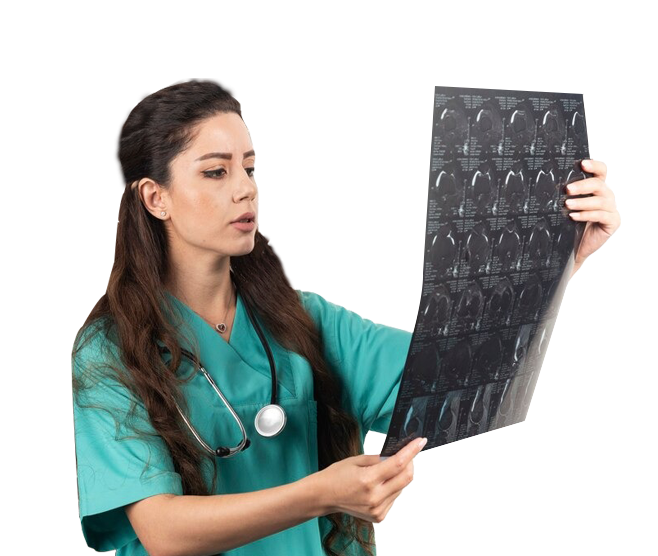
Modern medicine has been revolutionized by teleradiology because it allows for remote interpretation of medical images that leads to fast diagnosis and excellent health care delivery. Healthcare facilities and institutions use teleradiology services to solve their problems with shortage of radiologists, round-the-clock reporting, and availability of expert opinions.
Nevertheless, there are many challenges associated with teleradiology even though it offers many positive aspects. Knowledge of the challenges and ways to overcome them can assist healthcare institutions to benefit from teleradiology services to the fullest extent.
At RadPro Teleradiology, we are aware of the current challenges in the industry and work hard at adopting new technologies and techniques of high-quality reporting.
Teleradiology is the process of transmitting radiological images such as X-rays, CT scans, MRI scans, ultrasound images, and mammograms from one location to another for interpretation by qualified radiologists.
This technology enables healthcare facilities to obtain expert diagnostic opinions regardless of geographical boundaries, ensuring patients receive timely medical care.
Healthcare systems worldwide are facing increasing patient volumes while experiencing a shortage of experienced radiologists. Teleradiology helps bridge this gap by providing:
Despite these advantages, organizations must address several operational and technical challenges.
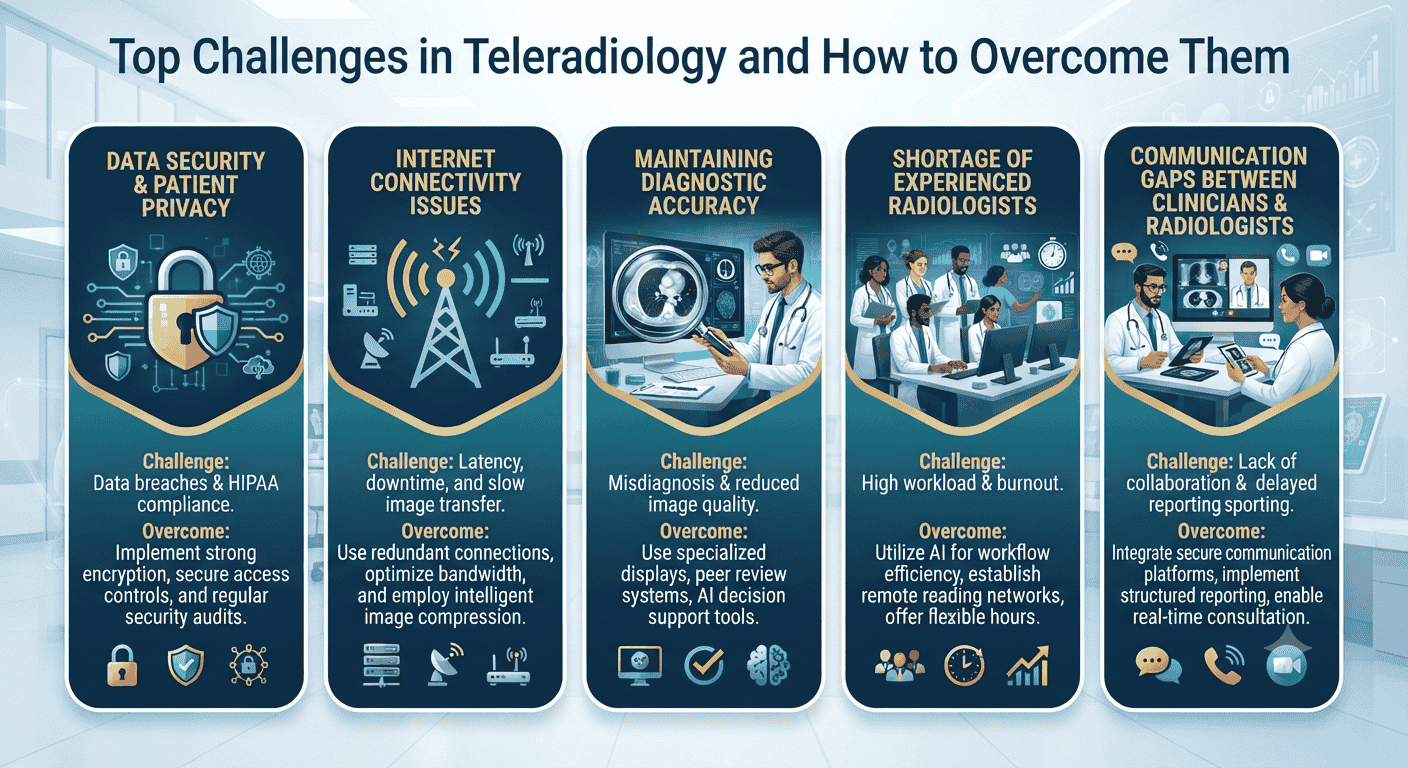
Medical imaging contains highly sensitive patient information. Since teleradiology relies heavily on digital transmission, maintaining data security is one of the biggest concerns.
Potential risks include:
Healthcare providers should:
Maintaining strict security protocols significantly reduces privacy risks.
High-resolution imaging files are often extremely large. Poor internet connectivity can delay image transmission, affecting emergency reporting and patient care.
Even minor network interruptions may impact reporting timelines.
Organizations should invest in:
Reliable connectivity ensures uninterrupted reporting.
Accurate diagnosis is the foundation of effective healthcare. Differences in monitor quality, image resolution, or incomplete patient information may affect reporting quality.
Radiologists also require access to previous imaging studies for comparison.
Healthcare providers can improve diagnostic accuracy by:
These practices help minimize reporting errors.
Many regions continue to face shortages of qualified radiologists, especially those specializing in neuroradiology, musculoskeletal imaging, pediatric radiology, and cardiac imaging.
This often increases reporting workload and turnaround times.
Partnering with experienced teleradiology providers allows healthcare facilities to access:
This significantly improves service availability.
Direct communication between referring physicians and radiologists is sometimes limited in remote reporting environments.
Without adequate clinical information, radiologists may face challenges in providing comprehensive interpretations.
Hospitals should:
Click one of our contacts below to chat on WhatsApp